 English
 Español
NEWS
NEWS
NEWS
NEWS
NEWS
NEWS
NEWS
NEWS
NEWS
NEWS
NEWS
NEWS
NEWS
NEWS
NEWS
NEWS

Peng Shulan — Regional Sales Consultant
Home / Author / Peng Shulan — Regional Sales Consultant / Precision Ground Bond Testing for Safer, More Reliable Electrical Products
Precision Ground Bond Testing for Safer, More Reliable Electrical Products
Content
- 1 Why Ground Bond Testing Matters
- 2 Overview of the TH9410A Series
- 3 Core Technical Advantages
- 4 Performance Specifications
- 5 Advantages Compared with Basic or Narrow-Range Testers
- 6 Applications Across Multiple Industries
- 7 Advanced Manufacturing and Engineering Strengths
- 8 Manufacturing Process Considerations
- 9 Integrating the Tester into an Automated System
- 10 Recommended Test Workflow
- 11 Maintenance and Measurement Reliability
- 12 Purchasing Considerations
- 13 Quality and Process Benefits for Manufacturers
- 14 Limitations and Responsible Use
- 15 Q&A: Common Questions About the Ground Bond Tester
- 15.1 What does the TH9410A measure?
- 15.2 What is the maximum test current?
- 15.3 Why is four-terminal testing important?
- 15.4 Can the tester be used for automated production?
- 15.5 How many test procedures can be stored?
- 15.6 What is the available test-time range?
- 15.7 What does the resistance relationship Rmax ≤ 6/Iset mean?
- 15.8 Is the TH9410A suitable for medical equipment?
- 15.9 Does the instrument replace all electrical safety tests?
- 15.10 What should be checked before ordering?
- 16 Conclusion
- 17 References
- 18 Product: TH9410A Series Backlit LCD Display Ground Bond Tester
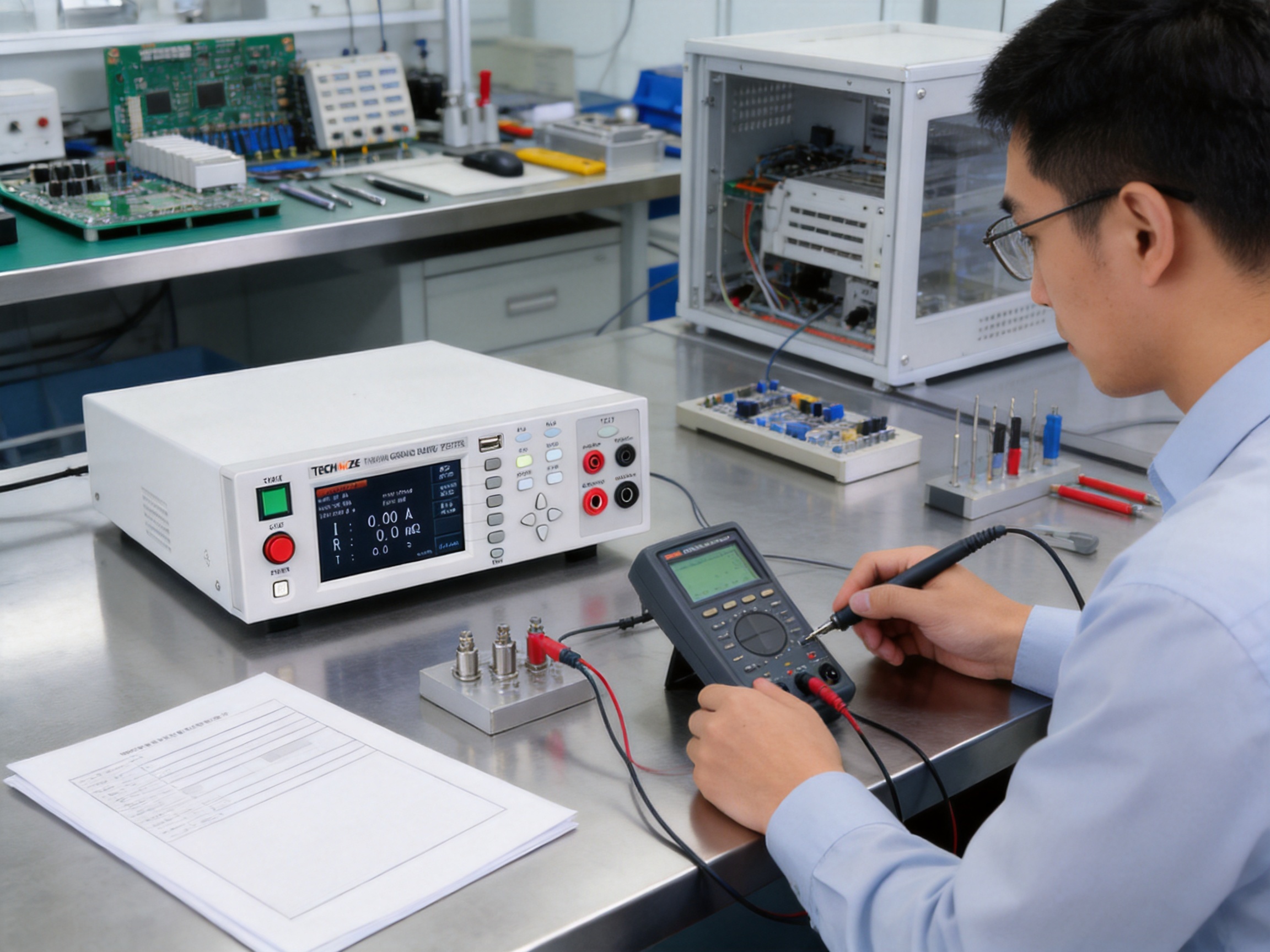
Electrical safety is not achieved by one inspection or one measurement. It depends on a structured verification process that confirms whether current can return safely through the intended protective grounding path. In appliances, motors, transformers, lighting products, medical equipment, electric heating devices, electronic assemblies, and new energy vehicles, even a small increase in grounding resistance can affect fault protection and product reliability. A professional ground bond tester is therefore an essential instrument for laboratories, production lines, quality departments, and automated test systems.
The TH9410A Series Backlit LCD Display Ground Bond Tester is designed for this purpose. It combines adjustable high-current output, low-resistance measurement, four-terminal testing, extended test timing, programmable test files, safety functions, and flexible system integration. Its specifications are intended to support both routine production inspection and more demanding laboratory verification.
With a test current adjustable from 1.00 A to 45.00 A and a grounding resistance measurement range extending to 600 mΩ under the specified conditions, the TH9410A can accommodate a broad selection of electrical safety applications. Its 480 × 272 dot TFT-LCD display provides clear visibility, while the independent power amplifier circuit helps maintain stable current output when supply or load conditions change.
Manufactured and supplied by JIANGSU BAISHENG INDUSTRIAL CO., LTD., the instrument reflects the company’s focus on precision laboratory equipment, safety testing technology, engineering development, and customized solutions. The company’s history combines electronic testing research, independent product development, production-line construction, and international technical service.
This article examines the operating value, technical advantages, manufacturing strengths, application possibilities, and purchasing considerations associated with the TH9410A Series Ground Bond Tester.
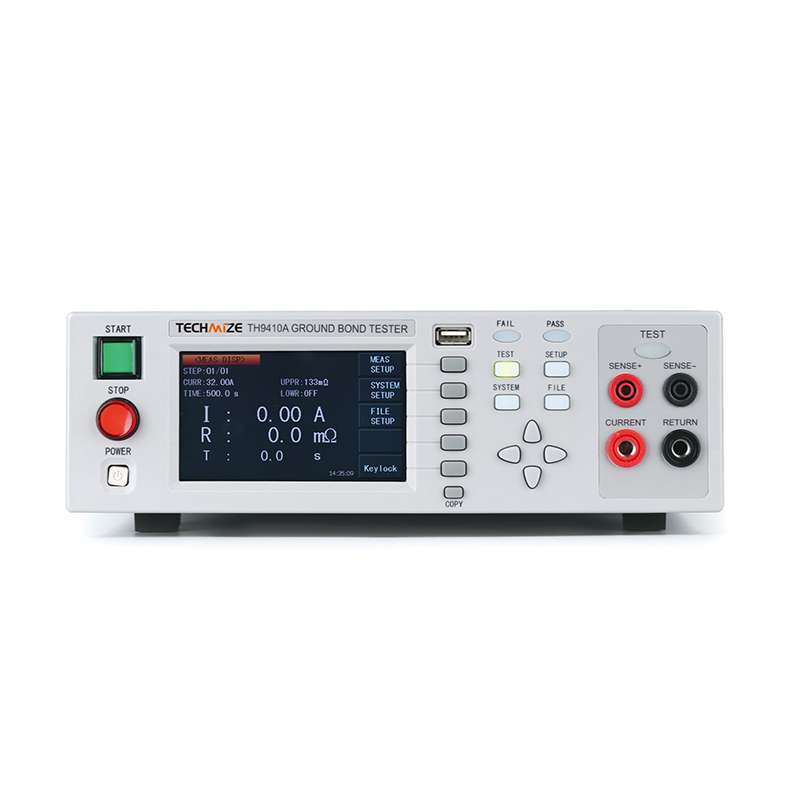
TH9410A Series Backlit LCD Display Ground Bond Tester
Why Ground Bond Testing Matters
Ground bond testing evaluates the integrity of the protective connection between accessible conductive parts and the protective earth or grounding terminal of an electrical product. During a fault, the grounding path must carry sufficient current to activate a protective device or otherwise prevent a dangerous voltage from remaining on an exposed surface. The resistance of that path is a fundamental safety characteristic.
A grounding connection can be weakened by loose fasteners, insufficient crimping, poor welding, contaminated contact surfaces, undersized conductors, damaged cables, incorrect assembly, or unsuitable materials. These problems may not be visible during ordinary functional testing. A product can turn on, operate normally, and still present a serious electrical safety risk if its protective grounding path is inadequate.
Ground bond testing provides a controlled way to identify such conditions. The tester applies a defined current through the grounding path and measures the resulting voltage drop. Based on the relationship between voltage, current, and resistance, the instrument determines whether the grounding connection falls within the selected limits.
For production manufacturers, the test is often performed at the end of an assembly process. It can confirm that a grounding wire has been connected correctly, that a metal enclosure is bonded properly, and that the final product meets an internal or applicable safety requirement. For research and development teams, ground bond testing can compare alternative designs, materials, terminals, fasteners, and assembly methods.
Reliable testing requires more than simply generating current. The instrument must deliver the programmed output consistently, measure very small resistance values accurately, compensate for the resistance of test leads, support repeatable test conditions, and protect operators from unintended activation. These requirements explain why a dedicated ground bond tester is preferable to improvised measurement equipment in professional environments.
Overview of the TH9410A Series
The TH9410A is a high-precision ground bond tester intended for electrical safety verification. It is designed to measure grounding resistance while supplying a controlled test current. The equipment is suitable for laboratory benches, production inspection stations, quality-control departments, and automated test systems.
The principal test current range is 1.00 A to 45.00 A. This broad range allows users to select a suitable current for different products and test procedures. Lower current settings may be appropriate for certain components or preliminary checks, while higher current settings can be used when a demanding ground bond evaluation is required.
The instrument measures resistance from 0 to 600 mΩ within the operating conditions specified in its technical data. The maximum measurable resistance depends on the selected current, with the relationship identified as Rmax ≤ 6/Iset. When the test current is below 10 A, the maximum resistance can reach 600 mΩ. This relationship should be considered when configuring a test method, especially when the target resistance is near the upper part of the range.
A four-terminal test mode is used to improve measurement accuracy. Two terminals deliver the test current, while two separate terminals sense the voltage at the device under test. This arrangement reduces the influence of test-lead resistance and contact resistance compared with a basic two-wire measurement method.
The tester includes a backlit 480 × 272 dot TFT-LCD display. The display is intended to make measurement values, test status, settings, and pass-or-fail information easier to view in different working environments. A clear display is particularly useful when the instrument is installed in a production station where operators must quickly confirm results.
Test time can be programmed from 0.5 seconds to 999.9 seconds, with a continuous mode available when the setting is zero. This is significantly more flexible than a fixed short-duration test. Users can establish brief checks for high-throughput production or longer test sequences for engineering evaluation and product qualification.
Core Technical Advantages
Wide Adjustable Test Current
The 1.00 A to 45.00 A test-current range is one of the instrument’s most important advantages. A ground bond tester with a narrow current range may be suitable for only a limited number of products or standards. By contrast, the TH9410A gives engineers more freedom to define test methods for household appliances, industrial equipment, motors, transformers, electronic assemblies, and other products with different grounding structures.
The setting and readback resolution is 0.01 A. This allows the operator to select and verify current with a level of detail appropriate for precision safety testing. The instrument’s current accuracy is specified as ±(2% of reading + 3 digits), providing a clear basis for evaluating measurement uncertainty and establishing internal acceptance procedures.
Adjustable current also helps manufacturers standardize multiple product families on one platform. Instead of purchasing separate instruments for lower- and higher-current ground bond tests, a production department may use one flexible tester across several workstations, provided that the selected procedure is appropriate for the product and applicable requirements.
Low-Resistance Measurement Capability
Grounding resistance is often very low, so the measurement system must resolve small differences. The TH9410A provides a resistance resolution of 1 mΩ in the lower-current range and 0.1 mΩ in specified higher-current ranges. Its resistance accuracy is listed as ±(2% of reading + 2 digits).
The instrument supports upper and lower resistance limits. The upper limit can be set from 0 to 600 mΩ, while the lower limit can also be configured within the supported range, provided that it remains below the upper limit. This allows the tester to distinguish between acceptable and unacceptable results automatically according to the defined procedure.
Limit settings are useful for both safety and process control. A result above the upper limit may indicate a defective grounding connection. A result below the lower limit may also require investigation if the test method expects a defined range or if an abnormal reading suggests incorrect connection, shorting, or an unsuitable setup. Programmable limits therefore help transform a raw measurement into a consistent production decision.
Four-Terminal Measurement
Four-terminal measurement, sometimes called Kelvin measurement, is essential when evaluating low resistance. In a conventional two-wire method, the same conductors carry test current and measure voltage. The resistance of those conductors and their contact points can become part of the measured value, creating an error that is especially significant when the device under test has very low resistance.
The four-terminal arrangement separates the current path from the sensing path. The current terminals apply the programmed current, while the sensing terminals measure the voltage directly across the grounding connection. Because the sensing circuit carries very little current, the voltage measurement is less affected by the resistance of the current leads.
This design gives the TH9410A a practical advantage over basic resistance meters and general-purpose instruments that are not optimized for ground bond testing. It improves repeatability, supports more trustworthy limit evaluation, and helps production engineers distinguish a genuine product condition from an error introduced by the test fixture.
Independent Power Amplifier Circuit
The independent power amplifier circuit drives the output current separately from the main power supply fluctuations and load variations. In a ground bond test, the load can vary significantly between products. Cable lengths, metal structures, contact conditions, and grounding paths may all affect the electrical load seen by the tester.
A dedicated output amplifier helps the instrument maintain controlled current under these changing conditions. This is important because the accuracy of a resistance calculation depends directly on the stability and known value of the applied current. If current changes unpredictably, the measurement can become less consistent and the test result can be harder to interpret.
The independent amplifier architecture also supports the tester’s high-current capability. It is an example of engineering design directed toward the actual requirements of ground bond testing rather than simply adapting a low-current resistance measurement circuit.
Extended Test Time
The TH9410A supports test times from 0.5 seconds to 999.9 seconds, as well as continuous operation. Many production tests can be completed quickly, but not every application should be limited to a short fixed interval. Some products require a longer current application to verify thermal stability, connection integrity, or behavior under an extended test condition.
The test-time accuracy is specified as ±(0.1% + 0.05 seconds), with a resolution of 0.1 seconds. This enables users to create repeatable test procedures. A production engineer can define a short test for throughput, while a laboratory engineer can choose a longer duration for design verification without changing instruments.
Extended timing is also useful when the tester is incorporated into a multi-step automatic sequence. A test controller can call the ground bond function for a defined interval, record the result, and then proceed to another safety or functional test.
Front and Rear Output Connections
The TH9410A provides front and rear panel output holes. This arrangement supports different installation styles. A laboratory user may prefer front-panel access for occasional manual testing, while a production line may route connections through the rear panel for a cleaner and more permanent setup.
The availability of both connection positions can simplify integration into a standard test chassis or automated test cabinet. It gives equipment designers greater freedom when arranging fixtures, interlocks, switching units, and operator access. Flexible physical connectivity can reduce the need for custom mechanical modifications during system installation.
Data Storage and Structured Testing
The tester can store up to 20 test files, with each file containing up to 20 test steps. This feature supports repeatable procedures for multiple products or production models. A file may contain a sequence of settings that operators can recall rather than entering each parameter manually.
Structured test storage helps reduce setup errors. In a busy production environment, a technician may work with several product variants that require different test currents, resistance limits, and test times. Saved files make it easier to associate each product with its approved test procedure.
Stored test steps are also beneficial in laboratory work. Engineers can use separate files for design prototypes, product revisions, incoming inspection, and final qualification. The ability to organize procedures inside the instrument supports a more consistent approach to testing.
Keyboard Lock and Safety Lock Functions
Safety testing involves potentially high output current, so operator protection and prevention of unintended operation are essential. The keyboard lock function helps prevent accidental changes to settings after a procedure has been approved. This is particularly valuable in production environments where several people may use the same instrument.
The safety lock function helps prevent accidental activation of the test state. It supports a controlled operating sequence in which the product, fixture, and connections are prepared before the output is enabled. These functions do not replace proper guarding, training, grounding, emergency-stop provisions, or workplace safety procedures, but they provide useful layers of control within the instrument.
Compared with an instrument that offers only measurement capability, the TH9410A therefore places greater emphasis on controlled operation. This is an important distinction when selecting equipment for repeated use by multiple operators.
Performance Specifications
The following table summarizes key specifications for the TH9410A ground bond tester. Users should confirm the final configuration, input-voltage requirement, accessories, and applicable test conditions with the supplier before ordering.
| Item | TH9410A Specification |
|---|---|
| Test current range | 1.00 A to 45.00 A |
| Current setting resolution | 0.01 A |
| Current readback resolution | 0.01 A |
| Current accuracy | ±(2% of reading + 3 digits) |
| Resistance test range | 0 to 600 mΩ under specified current conditions |
| Maximum resistance relationship | Rmax ≤ 6 / Iset; maximum resistance can be 600 mΩ when current is below 10 A |
| Resistance accuracy | ±(2% of reading + 2 digits) |
| Resistance resolution | 1 mΩ or 0.1 mΩ depending on operating range |
| Upper resistance limit | 0 to 600 mΩ |
| Lower resistance limit | 0 to 600 mΩ, below the upper limit |
| Test-time range | 0.5 to 999.9 seconds; 0 for continuous operation |
| Test-time resolution | 0.1 second |
| Test-time accuracy | ±(0.1% + 0.05 second) |
| Display | 480 × 272 dot backlit TFT-LCD |
| Input voltage | 110 V or 220 V |
| Input frequency | 47.5 to 63 Hz |
| Power consumption | Up to 900 VA for TH9410A |
| Data storage | Up to 20 test files, each with up to 20 test steps |
Advantages Compared with Basic or Narrow-Range Testers
Ground bond testers are available in many forms, from simple manual resistance instruments to advanced safety-test platforms. The correct comparison should consider the complete application rather than one isolated specification. For manufacturers that need flexible current output, low-resistance measurement, and repeatable production operation, the TH9410A offers several practical advantages.
More Flexible Than Fixed-Current Equipment
Some entry-level instruments operate at one or only a few fixed currents. Such products may be adequate for a narrow application, but they can become limiting when a manufacturer adds product models or changes a test method. The TH9410A’s adjustable 1.00 A to 45.00 A range supports a wider range of procedures without requiring a separate instrument for every current level.
More Suitable for Low-Resistance Evaluation
General-purpose digital multimeters may measure resistance, but they are not necessarily designed to apply high test current or compensate for lead resistance through a four-terminal arrangement. The TH9410A is specifically configured for grounding resistance evaluation, making it more appropriate for safety verification where low resistance and high current are central requirements.
Better Support for Production Repeatability
Manual instruments often depend heavily on operator judgment and repeated parameter entry. The TH9410A provides data storage, limit settings, test sequencing, keyboard locking, and safety locking. These features help production teams establish repeatable procedures and reduce variations caused by inconsistent operation.
More Practical for Automation
The front and rear output connections, stored test steps, and independent output circuit make the instrument suitable for integration into automated test systems. A manufacturer can incorporate it into a station with product fixtures, switching hardware, barcode identification, programmable controllers, and result-recording software, subject to the communication and system requirements of the final configuration.
Greater Timing Flexibility
A tester restricted to a short fixed duration may not meet the needs of every product or development program. The TH9410A supports short-duration production tests, longer laboratory evaluations, and continuous operation. This range gives engineering teams more freedom when designing validation procedures.
Applications Across Multiple Industries
Household Appliances
Household appliances commonly include metal frames, protective earth conductors, heating elements, motors, control boards, and user-accessible conductive surfaces. Ground bond testing can verify that the protective earth connection remains secure after assembly.
Applications may include washing machines, refrigerators, ovens, microwave equipment, air-conditioning products, vacuum cleaners, kitchen appliances, and other consumer devices. The stored test-file function can help a manufacturer maintain separate procedures for different appliance models, while the high-current capability supports verification of substantial grounding structures.
Transformers and Motors
Transformers and motors may contain metal housings, cores, frames, terminal boxes, and internal conductive components that require effective grounding. Manufacturing processes such as winding, assembly, fastening, painting, and enclosure installation can introduce variables into the protective path.
A controlled ground bond test can be used during final inspection or after a repair. The four-terminal measurement arrangement is especially useful when the expected resistance is low and the resistance of the test leads could otherwise influence the result.
Electric Heating Equipment
Electric heating appliances often operate at significant power levels and may include heating elements near metal housings or structural supports. A sound protective earth connection is essential when insulation or component failure could energize an exposed surface.
The TH9410A’s adjustable current and extended test duration enable test engineers to select a procedure appropriate for the equipment design. Higher-current testing can provide a demanding evaluation of the connection, while longer duration can support additional process studies where required.
Lighting Products
Lighting equipment may include metal bodies, reflectors, mounting structures, drivers, and protective earth terminals. Ground bond testing can help verify the electrical connection between those parts and the earth conductor.
For lighting manufacturers with many product variants, saved test files can improve changeover efficiency. Each file may contain product-specific limits and test timing, helping operators select an established procedure rather than relying on handwritten settings.
New Energy Vehicles
New energy vehicles and their associated components require disciplined electrical safety management. Battery-related systems, charging equipment, power conversion assemblies, electric drive units, and metal enclosures may require grounding verification depending on their design and applicable requirements.
The TH9410A can support component-level quality assurance and production inspection where grounding resistance must be evaluated. Test engineers should establish the correct current, resistance limit, fixture design, and safety controls based on the specific component and applicable technical documentation.
Electronic Components and Assemblies
Electronic equipment may contain conductive chassis parts, shielding structures, mounting plates, and grounding terminals. The integrity of these connections can affect both safety and electromagnetic performance.
A programmable ground bond test can be included in a broader assembly inspection process. When combined with other electrical safety tests, it can help manufacturers create a more complete release procedure for finished products and subassemblies.
Medical Equipment
Medical equipment demands careful attention to electrical safety because it may be used near patients, operators, and other connected devices. Grounding connections can occur in cabinets, frames, carts, enclosures, and power-entry assemblies.
The TH9410A can provide a repeatable grounding resistance measurement for suitable medical equipment applications. However, the test procedure must always be developed in accordance with the relevant product standards, risk analysis, design requirements, and internal quality system.
Advanced Manufacturing and Engineering Strengths
The performance of a test instrument depends on more than its front-panel specifications. Product development discipline, manufacturing control, calibration practices, inspection procedures, and technical support all influence the value of the equipment over its service life. JIANGSU BAISHENG INDUSTRIAL CO., LTD. presents itself as a technology-driven enterprise focused on laboratory equipment and safety testing instruments.
Research and Development Foundation
The company’s predecessor began in 2013 as a research and development studio specializing in electronic testing. This origin is significant because it indicates that the organization developed from engineering activities rather than operating solely as a conventional trading business.
The founding team included engineers with technical experience in laboratory equipment and safety compliance testing. Such a foundation supports a product-development approach that emphasizes measurement accuracy, circuit design, functional requirements, and practical use conditions.
Transition to Independent Production
In 2016, the organization transformed from a technical studio into an enterprise, completed its first independently developed production line, and launched laboratory equipment with independent intellectual property rights. A transition from development work to controlled production requires the ability to convert engineering designs into repeatable assemblies.
For an instrument such as the TH9410A, this means that the company must coordinate electronic components, power-amplifier circuits, measurement channels, display systems, mechanical structures, connectors, control functions, and final inspection. Production capability provides a foundation for improving consistency and responding to customer requirements.
Technology Plus International Trade
In 2019, the company adopted a “technology plus trade” development strategy. This approach combines product engineering with international market experience. For overseas customers, the combination can be valuable because technical specifications, application requirements, shipping considerations, documentation, and communication must all be managed together.
International customers often need more than a catalog item. They may require assistance with input-voltage selection, fixture arrangements, production-line integration, operating procedures, customized limits, or technical documentation. A supplier with both engineering and trade capabilities can provide a more coordinated purchasing experience.
Quality-System Improvement
In 2022, the company further improved its quality-management system, and its products underwent rigorous technical-specification certification processes according to the supplied company information. Quality-system development is important for laboratory and safety instruments because customers depend on stable performance, traceable procedures, and consistent manufacturing.
Customers evaluating a purchase should request the specific quality documents, calibration information, inspection records, and certification details applicable to the ordered model and destination market. The company’s stated quality focus provides a useful foundation, but final compliance should always be confirmed against the exact product configuration.
Continuous Product Upgrading
By 2025, the company continued to promote product innovation and technological upgrading while expanding application scenarios. This direction aligns with the needs of modern manufacturing, where test equipment increasingly supports digital procedures, automated stations, traceable records, and flexible production.
The TH9410A’s stored test files, multi-step capability, backlit display, safety locks, and front/rear connection options demonstrate attention to both measurement and workflow. These functions can help bridge the gap between a standalone bench instrument and a component within a larger quality-control system.
Manufacturing Process Considerations
Although the supplied materials do not disclose every production-stage detail, a precision ground bond tester requires a disciplined manufacturing process. The following areas are particularly important when evaluating the supplier and the instrument.
Electrical Assembly and Circuit Verification
The high-current output circuit must be assembled with suitable conductors, terminals, switching elements, protection components, and thermal considerations. The independent power amplifier must be verified under different load conditions to ensure that the output behaves as intended across the working range.
Measurement circuitry must be separated and controlled carefully so that high-current output does not introduce unacceptable errors into the low-resistance sensing channel. Four-terminal operation depends on correct routing of both current and sense connections, as well as appropriate circuit calibration.
Calibration and Accuracy Control
Accuracy specifications are meaningful only when supported by calibration and verification procedures. A professional manufacturing process should include reference instruments, known resistance standards, current verification, timing checks, display checks, and functional inspection.
The TH9410A’s stated current and resistance accuracy values give users a basis for defining acceptance criteria. Buyers should ask whether a calibration report is supplied, what points are tested, how often recalibration is recommended, and whether service support is available in the destination region.
Mechanical and Connector Inspection
Ground bond testing involves high current, so connector quality and mechanical integrity are important. Output sockets, cables, terminals, front-panel controls, rear-panel connections, and protective housing elements should be inspected during production. A loose or damaged connector can affect both safety and measurement stability.
The enclosure and control panel should also support practical operation. Clear markings, an easily readable display, accessible controls, and secure mounting points all contribute to efficient use in a laboratory or production environment.
Functional and Burn-In Testing
Functional testing should confirm that the instrument starts correctly, responds to controls, displays values clearly, executes stored test steps, applies limits, operates the safety lock, and completes tests at the selected times. Where appropriate, extended operation or burn-in testing can help identify intermittent issues before shipment.
Because the tester may be used for long production shifts, durability under repeated operation is an important consideration. A manufacturing process that includes systematic inspection and operational verification can improve confidence in the instrument’s suitability for demanding environments.
Integrating the Tester into an Automated System
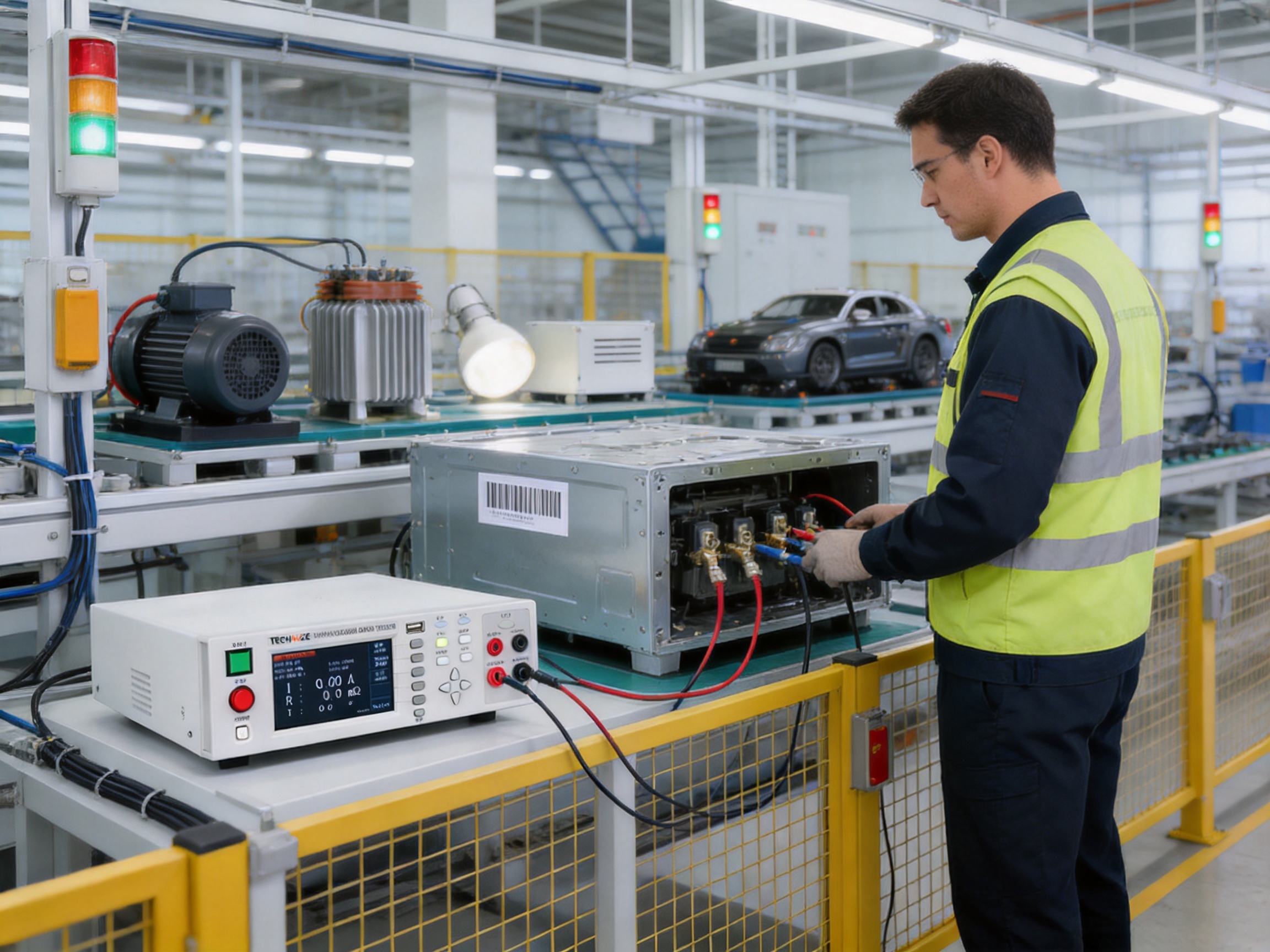
Automation can improve throughput, reduce operator variation, and create a traceable record of test results. The TH9410A is designed with features that support integration into standard test chassis and production stations.
A typical automated station may include a product fixture, an identification system, a programmable controller, safety interlocks, a switching network, a result recorder, and an operator interface. The ground bond tester supplies the test current and measures resistance, while the surrounding system controls product loading, fixture verification, and result handling.
Front and rear output holes allow system designers to choose a connection arrangement that suits the cabinet or bench layout. Rear-panel routing may be preferable for a permanent automated installation, while front-panel access can be helpful during setup, maintenance, or engineering changes.
Stored files and multiple test steps can simplify product changeover. A production system may assign one test file to each product family, provided that the operator or controller selects the correct file and verifies the product identity. This reduces the likelihood of using an incorrect current or limit.
Safety should remain the highest priority during integration. The automated station should prevent access to energized test points, confirm that the product is correctly seated, provide emergency-stop functionality, and prevent the test from beginning when the fixture is open or incomplete. The keyboard lock and safety lock functions of the instrument can complement, but not replace, system-level protections.
Recommended Test Workflow
A reliable ground bond procedure begins with preparation. Confirm that the tester is connected to the correct input voltage, that the test cables are in good condition, and that the current and sense leads are connected according to the four-terminal method. Inspect the fixture and product contact surfaces before starting.
Next, select or create the appropriate test file. Set the test current, upper resistance limit, lower resistance limit if required, and test time. Verify that the selected values match the approved product procedure. In production, this verification may be supported by barcode scanning, work instructions, or a controlled software interface.
Place the product into the fixture and ensure that the current terminals and sense terminals contact the intended points. The sense terminals should be positioned to measure the voltage across the connection being evaluated, not across an unrelated portion of the fixture. Poor contact can cause unstable readings or an incorrect pass-or-fail decision.
Activate the test only after confirming that the product is secure and that personnel are clear of exposed conductive parts. Observe the displayed current, resistance, test time, and result status. If the result fails, do not simply repeat the test without investigation. Inspect the grounding conductor, terminals, fasteners, contact surfaces, fixture, and test-lead arrangement.
After the test, record the result in accordance with the quality procedure. For automated production, the result may be linked to a product serial number or batch record. For laboratory work, retain the test file, product configuration, environmental conditions, and any relevant observations.
Maintenance and Measurement Reliability
Regular maintenance helps preserve measurement consistency. Test leads should be inspected for damaged insulation, worn terminals, loose connections, and signs of overheating. The fixture should be kept clean because oxidation, oil, paint, dust, and debris can affect contact resistance.
Users should periodically verify the instrument using suitable reference equipment or resistance standards. Calibration intervals depend on usage frequency, environmental conditions, internal quality requirements, and applicable regulations. A heavily used production tester may require more frequent verification than an instrument used occasionally in a controlled laboratory.
The display and controls should be checked during routine inspection. A backlit TFT-LCD can improve visibility, but operators should still confirm that all characters, measurement values, warning messages, and status indicators are readable.
Test procedures should also be reviewed when products, materials, fixtures, or standards change. An instrument may remain accurate while an outdated test file creates an unsuitable result. Document control is therefore as important as equipment maintenance.
Purchasing Considerations
Before purchasing a TH9410A, the buyer should define the required current range, expected resistance range, test duration, input voltage, installation method, fixture requirements, and data-management needs. The stated 110 V or 220 V input options should be matched to the electrical supply at the installation site.
It is also important to confirm whether the application requires only ground bond testing or a broader electrical safety platform. Some products may require additional tests such as insulation resistance, dielectric withstand, leakage current, or functional performance testing. The TH9410A is focused on ground bond measurement, so a complete production system may combine it with other instruments.
Buyers should request information about included cables, output connectors, manuals, calibration documents, shipping configuration, warranty terms, spare parts, and technical support. For automated installations, integration requirements should be discussed before ordering to ensure that the instrument and external control system are compatible.
The supplier’s stated ability to provide customized laboratory and safety-testing solutions may be useful for customers with special fixtures, product families, or production-line requirements. Customization should be documented clearly, including the accepted technical parameters, delivery schedule, inspection method, and responsibilities for system integration.
Quality and Process Benefits for Manufacturers
A ground bond tester contributes to more than final product safety. It can help manufacturers identify process weaknesses. If resistance values gradually increase over time, the trend may indicate tool wear, terminal contamination, conductor damage, or changes in assembly torque.
When test results are recorded consistently, quality teams can analyze failure rates by product model, shift, supplier, workstation, or manufacturing batch. This information supports corrective action and preventive improvement. A programmable tester with stored procedures helps ensure that the data is generated under consistent conditions.
The TH9410A’s adjustable limits can support different product designs while keeping the test method standardized. Its multi-step files can also help coordinate several test conditions within a controlled sequence. These capabilities are particularly useful when a manufacturer produces diverse equipment on the same production floor.
For engineering teams, the instrument can support design comparison. A grounding terminal, fastener, cable, enclosure, or bonding method can be evaluated under consistent current and timing conditions. This makes it easier to select designs that provide a robust safety margin rather than merely passing a single inspection.
Limitations and Responsible Use
No measuring instrument can compensate for an unsuitable test fixture or poorly defined procedure. The TH9410A should be used with appropriate cables, contacts, protective measures, and product-specific instructions. The resistance limit must be based on the product design and applicable requirements rather than chosen arbitrarily.
The stated resistance range is related to the selected test current. Users should calculate the expected maximum measurable resistance using the specified relationship and confirm that the chosen current is appropriate. Attempting to measure a resistance outside the instrument’s supported operating condition may lead to an invalid or incomplete result.
Ground bond testing is only one part of a complete electrical safety program. A product may pass ground bond testing and still fail insulation, dielectric, leakage, mechanical, thermal, or functional requirements. Manufacturers should use a complete risk-based test plan and apply relevant standards for the product category.
Operators should not bypass the keyboard lock, safety lock, fixture interlock, or other protective measures. High-current testing can create hazards if connections are loose, conductive parts are exposed, or the product is incorrectly positioned. Training, guarding, emergency procedures, and periodic safety review remain necessary.
Q&A: Common Questions About the Ground Bond Tester
What does the TH9410A measure?
The TH9410A measures grounding or protective-bond resistance while applying a controlled test current. It is intended to verify the integrity of conductive grounding paths in electrical products and assemblies.
What is the maximum test current?
The TH9410A provides an adjustable test current from 1.00 A to 45.00 A. The exact current should be selected according to the approved product test method and applicable requirements.
Why is four-terminal testing important?
Four-terminal testing separates the current-carrying conductors from the voltage-sensing conductors. This reduces the influence of test-lead and contact resistance, which is important when measuring very low grounding resistance.
Can the tester be used for automated production?
Yes. Its front and rear output connections, programmable test files, multiple test steps, adjustable limits, and safety-control functions make it suitable for integration into automated test systems. The final system should include appropriate fixtures, interlocks, guarding, and control logic.
How many test procedures can be stored?
The instrument can store up to 20 test files, and each file can contain up to 20 test steps. This supports repeatable procedures for different products or test sequences.
What is the available test-time range?
The test time can be set from 0.5 seconds to 999.9 seconds. A setting of zero provides continuous operation. The required duration should be determined by the product procedure rather than selected only for production speed.
What does the resistance relationship Rmax ≤ 6/Iset mean?
It means that the maximum measurable resistance depends on the selected test current. As the current increases, the supported maximum resistance becomes lower according to the specified relationship. When the current is below 10 A, the maximum resistance can reach 600 mΩ under the stated conditions.
Is the TH9410A suitable for medical equipment?
It can support suitable grounding-resistance measurements for medical equipment, provided that the test procedure, fixture, limits, and safety controls are established according to the relevant medical-equipment requirements and the product’s design documentation.
Does the instrument replace all electrical safety tests?
No. It is a ground bond tester. Many products also require insulation resistance, dielectric withstand, leakage current, polarity, functional, or other tests. The complete test plan should be based on the product risk assessment and applicable standards.
What should be checked before ordering?
Confirm the required current and resistance ranges, input voltage, test duration, accuracy, connector arrangement, stored-procedure needs, fixture design, calibration documentation, accessories, and automation requirements. It is also advisable to discuss customization and after-sales technical support with the supplier.
Conclusion
The TH9410A Series Backlit LCD Display Ground Bond Tester is designed to provide a dependable foundation for protective-ground verification. Its 1.00 A to 45.00 A adjustable current, low-resistance measurement capability, four-terminal test method, independent power amplifier circuit, extended test time, programmable limits, data storage, and operator-safety functions address the practical requirements of modern electrical safety testing.
Compared with basic fixed-current or general-purpose resistance instruments, it offers greater flexibility for laboratory and production applications. Its front and rear output connections and structured test-file capability also make it a practical candidate for automated test stations.
The product is supported by JIANGSU BAISHENG INDUSTRIAL CO., LTD., a technology-driven supplier with a background in electronic testing research, independent equipment development, production-line construction, international trade, and continuing quality-system improvement. The company’s engineering-oriented approach may be especially valuable for customers seeking customized laboratory testing equipment rather than a purely standard catalog instrument.
For the best results, the tester should be combined with a carefully designed fixture, verified cables, accurate limits, trained operators, regular calibration, and a complete electrical safety program. Used in this way, the TH9410A can help manufacturers improve test consistency, identify grounding defects, support process control, and deliver safer electrical products.
References
1. TH9410A Series Ground Bond Tester Technical Product Information, supplied product specifications.
2. Principles of Four-Terminal Kelvin Resistance Measurement, general electrical measurement engineering references.
3. Electrical Safety Testing Practices for Household and Industrial Equipment, laboratory quality-control guidance.
4. Product Safety Engineering and Protective Earthing Verification, general technical reference material.
5. Manufacturing Quality Management for Precision Laboratory Instruments, general production and calibration guidance.
6. JIANGSU BAISHENG INDUSTRIAL CO., LTD. Company Profile, history, engineering capabilities, and product-development information.
Product: TH9410A Series Backlit LCD Display Ground Bond Tester

PREV:Cryogenic Environmental Chambers for Reliable Low-Temperature Sample Preparation and Analysis
NEXT:Advanced AC/DC/IR Withstand Voltage Testing for Safer Electrical Products
NEXT:Advanced AC/DC/IR Withstand Voltage Testing for Safer Electrical Products
Interested in cooperation or have questions?
Featured Products
Related products
Quick Link
Contact Information
- Tel: +86-13861043568
- E-mail: 1840784112@qq.com
- Add: Tianting District, Changzhou City, Jiangsu Province, China, No. 6 Hecircuit
Scan Code
Copyright © JIANGSU BAISHENG INDUSTRIAL CO., LTD.
All Rights Reserved. Privacy Custom Precision Laboratory Testing Equipment Manufacturers
