 English
 Español
NEWS
NEWS
NEWS
NEWS
NEWS
NEWS
NEWS
NEWS
NEWS
NEWS
NEWS
NEWS
NEWS
NEWS
NEWS
NEWS

Peng Shulan — Regional Sales Consultant
Home / Author / Peng Shulan — Regional Sales Consultant / Advanced AC/DC Withstanding Voltage and Insulation Resistance Testing for Modern Electrical Safety
Advanced AC/DC Withstanding Voltage and Insulation Resistance Testing for Modern Electrical Safety
Content
- 1 Why Electrical Safety Testing Requires a High-Performance Instrument
- 2 Overview of the TH9120 Series
- 3 Integrated Test Modes for More Efficient Workflows
- 4 Precision, Control, and Repeatability
- 5 Programmable Timing for Realistic Test Procedures
- 6 Safety Protection for High-Voltage Operation
- 7 Automation, Data Storage, and Interface Connectivity
- 8 Applications Across Electrical and High-Voltage Industries
- 9 Advantages Compared with Basic or Single-Function Testers
- 10 Manufacturing and Engineering Strengths
- 11 Recommended Test Workflow
- 12 Technical Specification Summary
- 13 Environmental and Installation Considerations
- 14 Quality Management and Long-Term Value
- 15 Selection Guidance for Different Users
- 16 Q&A
- 16.1 What is the main purpose of the TH9120 Series?
- 16.2 Which model provides the widest range of functions?
- 16.3 What is the maximum AC test voltage?
- 16.4 What is the maximum DC test voltage?
- 16.5 What insulation resistance range can the instrument measure?
- 16.6 Can the tester be used in an automated production line?
- 16.7 How many test programs can be stored?
- 16.8 Does the instrument discharge the product after DC testing?
- 16.9 What safety features are included?
- 16.10 Can the tester be used for electric vehicle components?
- 16.11 What should be considered when purchasing the instrument?
- 17 Conclusion
- 18 References
- 19 Product: TH9120 Series AC/DC Withstanding Voltage & Insulation Resistance Hipot Tester
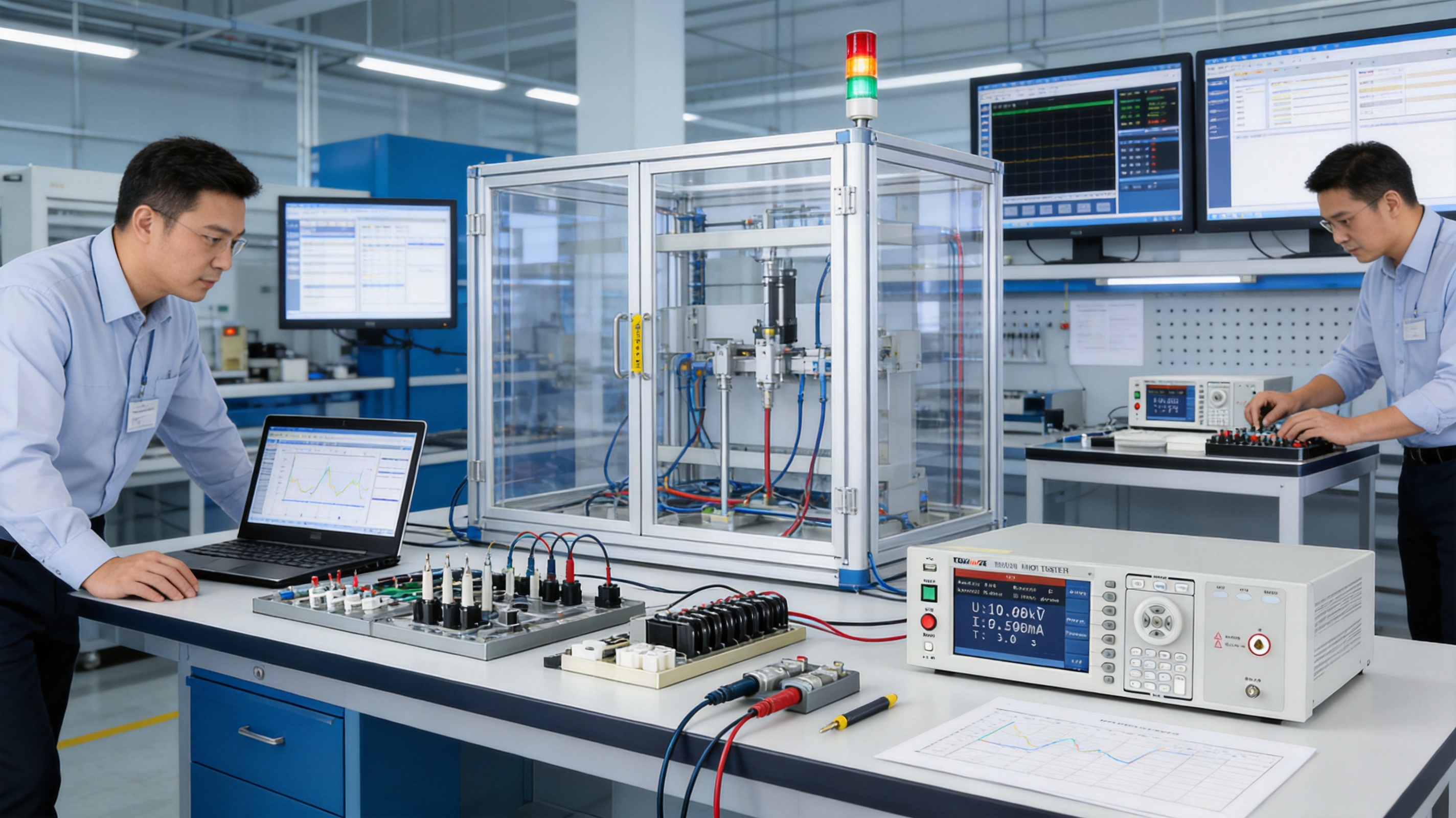
Electrical safety testing is a fundamental requirement in the design, production, inspection, and maintenance of electrical products. As equipment becomes more compact, powerful, connected, and energy-efficient, the insulation systems used in products must withstand higher electrical stresses while maintaining stable performance over time. A reliable test instrument is therefore essential for identifying insulation defects, leakage paths, dielectric weaknesses, assembly problems, and unsafe electrical connections before products reach customers or enter service.
The TH9120 Series AC/DC Withstanding Voltage & Insulation Resistance Hipot Tester is designed to address these demands with a combination of high-voltage withstand testing, insulation resistance measurement, arc detection, open-circuit and short-circuit detection, programmable test sequences, data storage, and automated system connectivity. It is intended for laboratories, production lines, quality-control departments, component manufacturers, electrical product manufacturers, and organizations responsible for safety compliance testing.
Unlike a basic single-function hipot tester, the TH9120 Series combines multiple safety-test capabilities in one platform. Depending on the selected model, users can perform AC withstand voltage, DC withstand voltage, insulation resistance, open-and-short detection, and arc-related testing. This integrated design reduces the need to operate several separate instruments and supports a more consistent testing workflow.
Why Electrical Safety Testing Requires a High-Performance Instrument
Insulation is used to separate conductors from one another and to prevent dangerous current from reaching users, enclosures, chassis parts, or other accessible surfaces. Although insulation materials may appear intact, microscopic defects, contamination, voids, mechanical damage, insufficient creepage distance, poor assembly, and manufacturing variation can create electrical weaknesses that are not visible during ordinary inspection.
A withstanding voltage test, often called a dielectric strength test or hipot test, applies a voltage significantly higher than the product’s normal operating voltage. The purpose is to verify that the insulation can tolerate a defined electrical stress without breakdown, excessive leakage current, flashover, or other unacceptable behavior. This test is particularly important for products connected to mains supplies, high-voltage circuits, power conversion systems, motors, transformers, battery systems, and high-voltage components.
Insulation resistance testing has a related but different purpose. It measures the resistance between separated conductive parts by applying a DC test voltage. A high resistance value generally indicates effective insulation, while a lower value may indicate moisture, contamination, material degradation, an assembly fault, or an unintended conductive path. Combining withstand voltage testing with insulation resistance testing gives engineers a broader view of electrical safety performance.
AC and DC testing provide different information. AC testing is useful for examining insulation under alternating electrical stress and is widely used for many mains-powered products and components. DC testing can be advantageous when testing capacitive devices, batteries, cables, filters, and assemblies where controlled charging and discharge behavior must be considered. The TH9120 Series supports both modes in its full-feature configuration, allowing users to select the most appropriate method for their application.
Overview of the TH9120 Series
The TH9120 Series is a high-precision, high-performance electrical safety tester with a maximum AC withstand voltage test range of 0.05 to 10.0 kV and a maximum DC withstand voltage test range of 0.05 to 12.0 kV. Its high-voltage capability makes it suitable for ordinary electrical products as well as demanding high-voltage components and insulating materials.
The series includes three configurations. The TH9120 is the broadest configuration and supports AC, DC, insulation resistance, and open-and-short detection. The TH9120A supports AC and open-and-short detection. The TH9120D supports DC and insulation resistance testing. This model structure allows users to select the equipment configuration that matches their testing process rather than paying for functions that are not required.
In the full configuration, AC output power is rated at 200 VA, corresponding to 10.0 kV and 20 mA. DC output power is rated at 120 VA, corresponding to 12.0 kV and 10 mA. The instrument provides a voltage resolution of 2 V and controlled voltage accuracy of up to ±(1% of the setting value + 0.1% of full scale) for withstand voltage testing. These specifications support repeatable test conditions and help reduce uncertainty in production and laboratory measurements.
The instrument is equipped with a seven-inch high-resolution touchscreen. The display provides an intuitive interface for configuring test modes, setting voltage and current limits, defining timing parameters, reviewing results, and managing stored test programs. A one-touch screenshot function also supports convenient recording of test information during engineering evaluation, troubleshooting, and quality inspections.
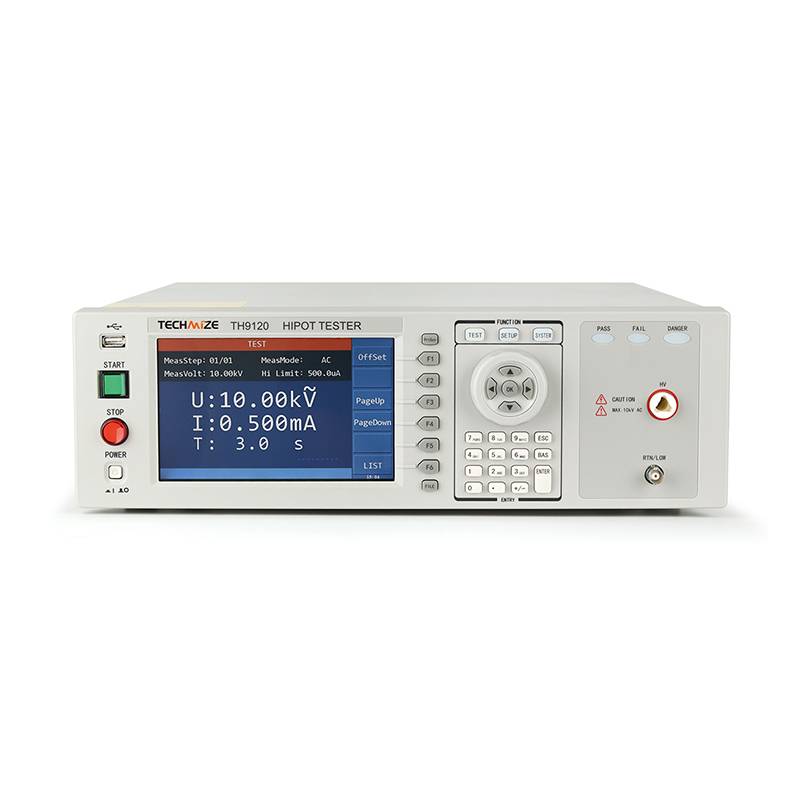
TH9120 Series AC/DC Withstanding Voltage & Insulation Resistance Hipot Tester
Integrated Test Modes for More Efficient Workflows
AC Withstanding Voltage Testing
AC withstand voltage testing applies a sinusoidal high-voltage output at 50 or 60 Hz. The TH9120 Series provides an AC output range of 0.05 to 10.0 kV and a nominal output capability of 200 VA. The instrument monitors current during the test and can identify a failure when the measured current exceeds the programmed limit or when another defined failure condition occurs.
AC testing is commonly used for household appliances, information technology equipment, audio-visual equipment, lighting products, electric heating appliances, wiring assemblies, relays, switches, and other products that must maintain safe isolation during operation. The controlled output and programmable test timing allow manufacturers to establish repeatable production inspection procedures.
The AC current test range is specified from 0.001 mA to 20 mA. Depending on the measurement range, current accuracy is specified as ±(1% of reading + 0.5% of full scale) or ±(1.5% of reading + 0.5% of full scale). This provides the measurement resolution needed for detecting leakage behavior while supporting practical high-voltage production testing.
DC Withstanding Voltage Testing
DC withstand testing provides an output range of 0.05 to 12.0 kV and an output capability of 120 VA at 12.0 kV and 10 mA. DC testing is particularly useful for products and components with capacitive characteristics, including cables, battery modules, filters, high-voltage assemblies, and certain insulating structures.
Because a capacitive product can retain charge after a DC test, the instrument includes an automatic discharge function after DC withstand testing. This feature contributes to safer operation by reducing residual high voltage on the device under test. The discharge process should still be supported by suitable external safety procedures, enclosures, warning systems, and verification practices appropriate to the test environment.
The DC current range extends from 0.0001 mA to 10 mA, with a stated resolution of 0.1 microampere in the applicable configuration. DC current accuracy is specified as ±(1% of reading + 0.5% of full scale). This level of sensitivity helps users identify small changes in leakage current that may indicate an insulation problem.
Insulation Resistance Measurement
The insulation resistance function applies a DC voltage from 0.05 to 12.0 kV and measures resistance from 0.1 megohm to 50.0 gigohms. This very broad measurement range enables the instrument to evaluate both relatively low resistance conditions and high-resistance insulation systems.
For test voltages of 5.0 kV or higher, the specified resistance accuracy includes ±(3% of reading + 0.1% of full scale) over the 1 megohm to 1 gigohm range. Additional accuracy specifications apply to higher resistance ranges, including 1 to 10 gigohms and 10 to 50 gigohms. At lower test voltages, the instrument supports resistance measurements from 0.1 megohm to 1 gigohm with a stated accuracy of ±(5% of reading + 2% of full scale).
Insulation resistance results can help engineers assess material quality, compare production batches, identify contamination, detect moisture-related changes, and determine whether an assembly has been correctly manufactured. When combined with a withstand voltage result, resistance measurement gives a more complete safety profile than either test alone.
Open and Short Detection
The OSC function supports open-circuit and short-circuit detection by using a sampling standard capacitance range of 0.001 to 40 nF. The open-circuit judgment range is 10% to 100%, while the short-circuit judgment range is 100% to 500%. These functions can be useful when checking capacitive components, wiring assemblies, connectors, and products where an incorrect connection or missing connection could produce an invalid high-voltage test result.
Open and short detection helps distinguish between a genuine insulation test and a test affected by an incomplete fixture connection or an unintended short. This is especially valuable in production environments, where fixture errors can otherwise lead to false conclusions, unnecessary rework, or missed defects.
Precision, Control, and Repeatability
Reliable electrical safety testing depends on more than a high maximum voltage. The tester must also control voltage accurately, measure current consistently, handle different load conditions, and apply the test for a defined duration. Variations in test conditions can make it difficult to compare results between products, production batches, operators, or facilities.
The TH9120 Series provides 2 V voltage resolution. Its withstand voltage accuracy is specified as ±(1% of the setting value + 0.1% of full scale), while the insulation resistance voltage accuracy is specified as ±(1% of the setting value + 0.5% of full scale). A stated load change rate of ±(1% of the setting value + 10 V) at rated power indicates that the design is intended to maintain controlled output when the test load changes within the instrument’s rated capability.
Current monitoring is equally important because leakage current is often the primary pass or fail criterion in a dielectric strength test. The tester provides separate AC and DC current ranges and accuracy specifications. The AC test range reaches 20 mA, while the DC test range reaches 10 mA. In AC-only testing, the maximum short-circuit current is specified as 40 mA.
These capabilities are beneficial in both development laboratories and manufacturing operations. In research and development, engineers can examine how insulation behaves during voltage increases, timed exposure, and different measurement modes. In production, quality teams can use programmed limits and repeatable sequences to reduce operator-dependent variation.
Programmable Timing for Realistic Test Procedures
Electrical safety standards and internal quality procedures often require more than simply applying a voltage. A test may need a controlled rise period, a waiting period, a defined dwell time, and a controlled fall period. The TH9120 Series provides programmable test time, rise time, fall time, and waiting time settings.
Test time can be set from 0.3 to 999 seconds, with zero representing continuous testing. Rise time and fall time can each be set from 0.1 to 999 seconds, with zero allowing the corresponding function to be turned off. A waiting time from 0.1 to 999 seconds is available for DC withstand voltage testing, with zero turning the function off.
A controlled voltage ramp can reduce unnecessary stress caused by an abrupt application of high voltage. It can also provide a more consistent test procedure for products with capacitive input structures or complex insulation systems. The waiting period allows the device under test to stabilize before the main measurement begins, while the fall time supports a controlled reduction of voltage at the end of the test.
Programmable timing is particularly useful when a company operates several production lines or supplies products to different markets. Standardized programs can be created for different product models, reducing the risk that an operator will accidentally use an incorrect voltage, limit, or duration.
Safety Protection for High-Voltage Operation
High-voltage equipment must be designed with safety functions that help limit operator exposure and prevent unintended energization. The TH9120 Series includes shock protection, start protection through an interlock, panel operation protection, alarm indication, and automatic DC discharge after testing.
The shock protection function is specified at 0.5 mA ± 0.25 mA and can be configured on or off according to the applicable operating procedure. The start protection interlock permits high-voltage output when the interlock pin is connected with the low terminal. This function can be integrated with a safety enclosure, door switch, fixture, or other external protective system.
Panel operation protection includes key lock and password functions. These controls can help prevent unauthorized changes to test programs and operating parameters. In a production environment, restricting access to critical settings supports process discipline and protects the validity of test results.
Pass and fail conditions are indicated by different audible and visual signals. A pass result produces a short sound and green light, while a fail result produces a long sound and red light. Clear result indication is helpful when operators must process many units in sequence and need to identify failed products quickly.
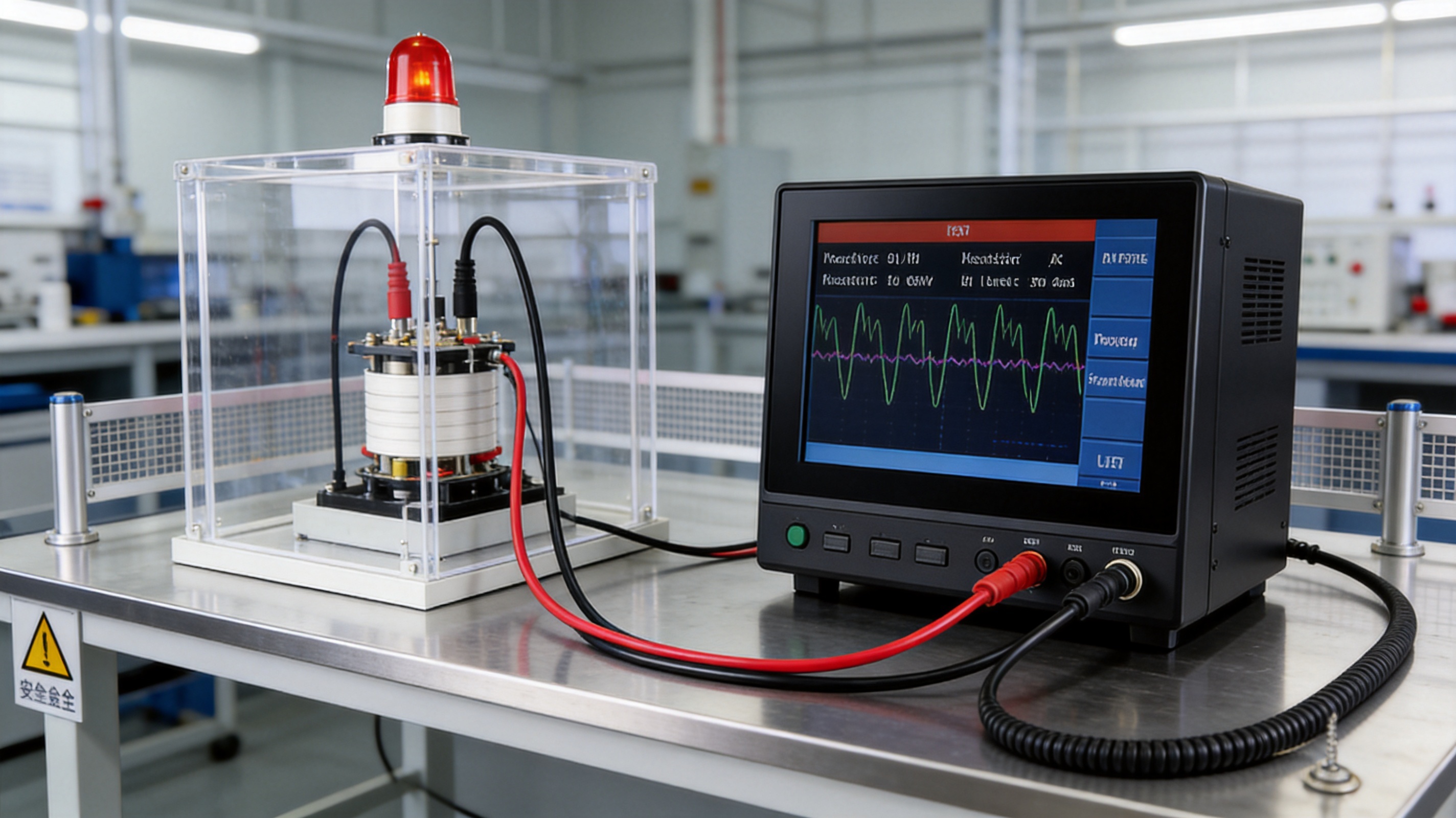
Safety functions are not a substitute for a properly engineered test station. Users should apply suitable barriers, grounding, warning labels, emergency stop arrangements, insulated fixtures, access controls, discharge verification, operator training, and procedures based on the voltage and energy level of the application. The instrument is best used as part of a complete high-voltage safety system.
Automation, Data Storage, and Interface Connectivity
Modern manufacturing increasingly depends on automated inspection, traceability, and digital production records. The TH9120 Series supports up to 100 files, with up to 50 editable steps in each file. This provides substantial capacity for storing product-specific test sequences, engineering experiments, inspection routines, and different versions of a manufacturing program.
Stored files can reduce setup time and promote consistency between operators. A program may contain the selected test mode, voltage, current limit, test time, rise time, fall time, waiting time, and other relevant settings. Once a validated program has been created, it can be recalled for repeated use instead of being entered manually for every test.
The standard interfaces include RS232, USB device, USB host, LAN, and HANDLER. GPIB is available as an optional interface. These connections support integration with automatic test equipment, manufacturing execution systems, computers, programmable controllers, barcode systems, fixtures, and production line control platforms.
In an automated system, the instrument can receive a command to load a test program, begin a test, report a pass or fail result, and communicate measured values to a host system. The HANDLER interface can be used for coordination with external production equipment, subject to the design of the overall system. Such integration can reduce manual data entry and make it easier to associate a test result with a product serial number or batch number.
Data storage and digital communication also support quality analysis. Engineers can compare results across production lots, identify gradual changes in leakage current or insulation resistance, investigate recurring failures, and establish more effective preventive maintenance procedures. The one-touch screenshot function is useful for capturing displayed information during development, service, or customer communication.
Applications Across Electrical and High-Voltage Industries
Household Appliances
Household appliances such as washing machines, refrigerators, ovens, heating appliances, air-conditioning products, and small kitchen equipment contain mains-connected circuits and accessible external surfaces. Withstand voltage and insulation resistance tests can help verify that internal conductors remain safely isolated from the enclosure and from other conductive parts.
The instrument’s programmable test sequences support high-volume production inspection. Manufacturers can establish separate programs for different appliance models, each with its own test voltage, leakage-current limit, and duration. The result indication and interlock functions are especially valuable on production lines where operator safety and rapid judgment are important.
Information and Audio-Visual Equipment
Information products, communication equipment, displays, audio systems, and related devices may contain switching power supplies, high-frequency circuits, metal shielding, and multiple internal voltage domains. Safety testing helps verify the separation between hazardous voltage circuits and user-accessible parts.
AC testing can be applied to mains input insulation, while DC testing and insulation resistance measurement can assist with specific subassemblies. Open and short detection may also be useful when inspecting cable harnesses, connectors, and capacitive input circuits.
Wires, Cables, and Insulating Materials
Cables and wires must maintain insulation along their entire length. A manufacturing defect, damaged jacket, poor termination, or contamination can reduce electrical safety. The TH9120 Series can be used in laboratory inspection and selected production applications for high-voltage withstand and insulation resistance testing.
Non-woven fabrics, polymer films, insulating sheets, molded materials, and other non-electrical products can also require electrical safety evaluation when they are used as insulation. The wide resistance range and high test voltage capability give engineers flexibility when developing material test methods.
High-Voltage Components
High-voltage optocouplers, relays, switches, contactors, connectors, and insulating assemblies require careful evaluation because their functional role depends on reliable isolation. The instrument can apply controlled AC or DC stress and monitor current behavior to identify weaknesses that may not be detected through visual inspection or low-voltage continuity checks.
Component manufacturers can use the tester during incoming inspection, process verification, final inspection, failure analysis, and design validation. Test programs can be organized by component type, rated voltage, production stage, or customer requirement.
New Energy Vehicles and Battery Systems
Electric vehicles and hybrid vehicles contain high-voltage battery packs, power inverters, charging systems, electric motors, compressors, heaters, and high-voltage distribution assemblies. Electrical isolation is essential because service personnel and vehicle occupants must be protected from hazardous voltage.
The TH9120 Series can support testing of battery modules, electrical systems, cables, connectors, and related components, provided that the selected test method and voltage are appropriate for the device under test. DC withstand voltage and insulation resistance functions are particularly relevant to battery-related assemblies, while AC testing may be used for suitable components and manufacturing procedures.
Testing high-energy battery systems requires special attention to stored energy, thermal behavior, fixture design, discharge time, and emergency response. The tester’s automatic discharge function supports safer DC testing, but the complete test installation must be designed for the energy capacity and fault conditions of the battery system.
Automated Test Stations
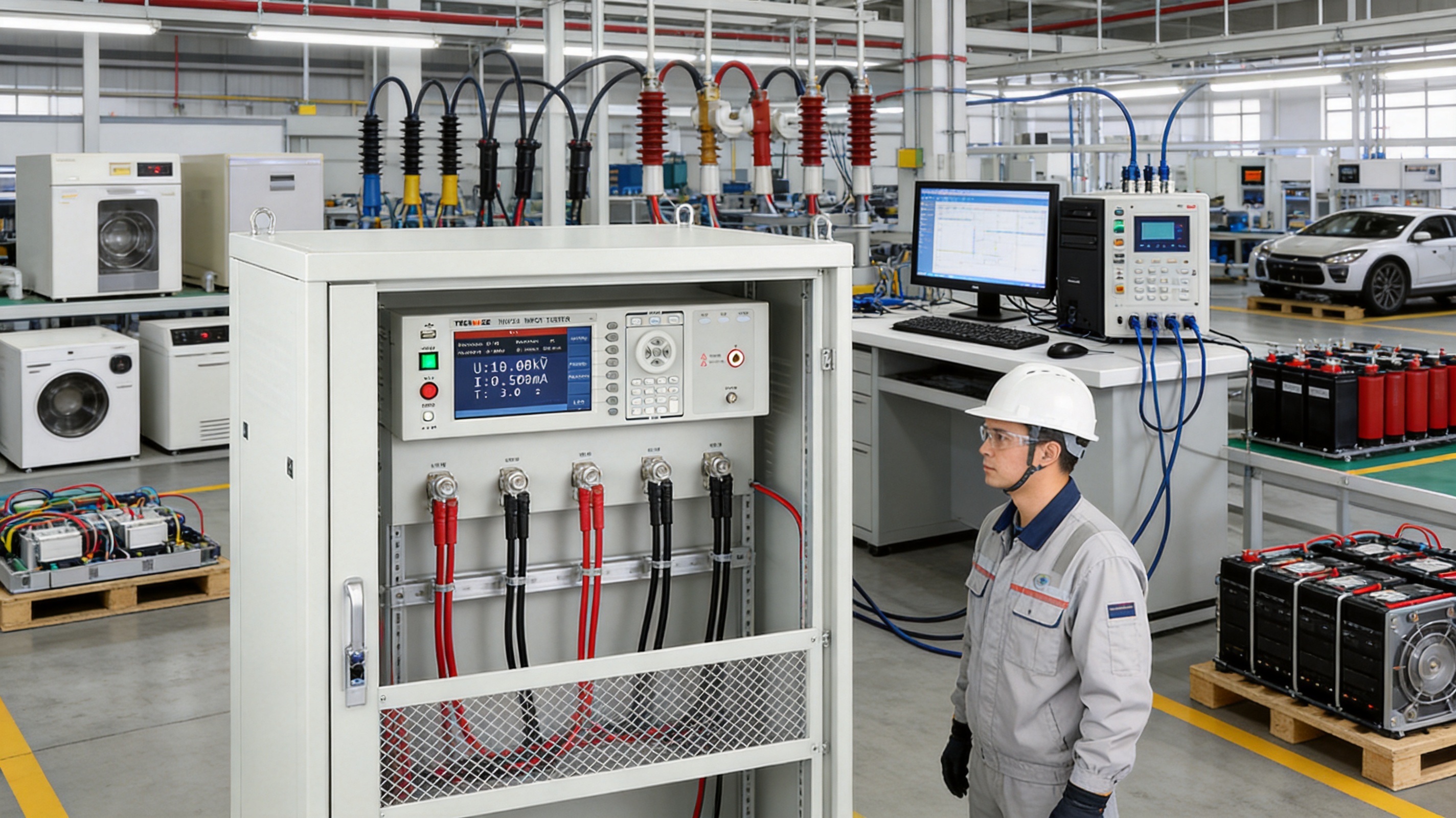
Manufacturers seeking higher throughput can integrate the instrument into an automated test station. A station may include a product fixture, safety enclosure, barcode reader, programmable controller, computer, and data management software. The tester’s communication interfaces provide a foundation for coordinating these elements.
Automation can improve repeatability by controlling product placement, test selection, timing, result recording, and release decisions. It can also reduce the risk of operators touching the device under test during high-voltage operation. When properly designed, an automated station can increase production efficiency while improving traceability and safety discipline.
Advantages Compared with Basic or Single-Function Testers
The first major advantage of the TH9120 Series is functional integration. A basic hipot tester may provide only AC or DC withstand testing, while the full TH9120 configuration adds insulation resistance, open-and-short detection, and broader test sequencing. This reduces instrument changes and simplifies the test architecture.
The second advantage is voltage range. With AC testing up to 10.0 kV and DC testing up to 12.0 kV, the series can address applications beyond ordinary low-voltage product inspection. This makes it suitable for high-voltage components, advanced insulation materials, cables, battery-related assemblies, and specialized electrical products.
The third advantage is measurement breadth. The insulation resistance range reaches 50.0 gigohms, allowing users to evaluate both moderate and very high resistance conditions. A wide measurement range is useful when one product family includes different insulation materials, voltage ratings, or construction designs.
The fourth advantage is programmable control. Rise time, fall time, waiting time, and test duration can be configured rather than relying on a simple fixed-voltage, fixed-time procedure. This enables more realistic and standardized testing for products with different electrical characteristics.
The fifth advantage is system readiness. RS232, USB, LAN, HANDLER, and optional GPIB connectivity make the instrument suitable for integration with laboratory computers and production systems. In comparison, manually operated instruments may require additional equipment or more operator involvement to achieve the same level of process control.
The sixth advantage is safety-oriented design. Interlock support, key lock, password protection, shock protection, clear pass/fail signaling, and automatic DC discharge help address practical risks associated with high-voltage testing. These functions can contribute to a safer and more controlled test environment when combined with proper external safeguards.
Manufacturing and Engineering Strengths
The manufacturer behind the TH9120 Series is a technology-driven enterprise established in 2010 and focused on laboratory equipment and safety testing instruments. Its stated development model combines product research and development with international trade experience. This combination is important because laboratory instruments must satisfy both technical requirements and the practical expectations of users in different industries and regions.
The company’s history began with an electronic testing research and development studio in 2013. The founding engineers had technical backgrounds in laboratory equipment and safety compliance testing. In 2016, the organization developed its first independent production line and introduced laboratory equipment with independent intellectual property rights. This progression suggests a manufacturing approach based on in-house engineering development rather than relying exclusively on external sourcing.
In 2019, the company adopted a technology and trade development strategy and increased investment in research and development. It also introduced additional technical talent and expanded overseas markets. For customers, this type of development can be valuable because export-oriented product design often requires attention to documentation, communication, application support, and consistent product configuration.
The company further improved its quality management system in 2022 and reports that its products passed rigorous technical specification certifications. Specific certification details should be confirmed for the exact model, configuration, destination market, and purchase order. Nevertheless, the stated emphasis on quality systems reflects the importance of controlled design, inspection, assembly, and documentation in the production of high-voltage test equipment.
By 2025, the company continued to promote product innovation and technological upgrading while adapting its product applications to intelligent and digitalized manufacturing trends. The TH9120 Series reflects this direction through programmable test files, touchscreen control, screenshot recording, and multiple communication interfaces.
Research and Development Orientation
A dedicated research and development capability can improve the ability to customize electrical safety testers for specific products. Different users may require special fixtures, communication protocols, test limits, timing sequences, output configurations, or integration with existing production systems. An engineering-centered manufacturer is better positioned to discuss these requirements at the design stage.
The company describes its core advantage as a professional research and development team focused on precision design and technical excellence. For a high-voltage instrument, precision design includes the control of output voltage, current measurement, insulation between internal circuits, thermal management, protection functions, user interface, and long-term reliability.
Controlled Assembly and Inspection
The manufacturing process for a high-voltage tester must pay close attention to electrical clearances, insulation structures, grounding paths, wiring quality, component selection, and enclosure construction. High-voltage assemblies require careful routing and separation to reduce the risk of unintended discharge or interference. Measurement circuits also require suitable shielding, calibration, and verification procedures.
Although detailed factory process records are not included in the supplied product materials, the company’s stated focus on precision design and quality management provides a foundation for discussing its manufacturing strengths. Customers evaluating a purchase should request information about incoming component inspection, high-voltage safety testing, calibration procedures, final inspection records, software version control, and production traceability.
Customization Capability
Customization is often necessary when a tester is installed in a specialized production line. Products may have unusual connectors, complex fixtures, multiple test points, or strict cycle-time requirements. The TH9120 Series already provides several interfaces and programmable steps, which can simplify adaptation to different processes.
A manufacturer with both engineering and trade experience can support communication from technical specification through delivery. This is particularly useful for international customers that require customized documentation, remote application discussions, packaging requirements, spare parts, training materials, and after-sales coordination.
Recommended Test Workflow
A safe and repeatable test procedure should begin with a documented test plan. The plan should identify the product, test points, test mode, voltage, current or resistance limit, rise time, dwell time, discharge requirements, acceptance criteria, and failure-handling procedure. The test plan should be reviewed by qualified engineering and safety personnel before it is released for production.
The next step is fixture preparation. The fixture must hold the product securely and provide reliable electrical contact without exposing the operator to energized parts. Insulated supports, barriers, grounding connections, interlock switches, and emergency stop controls should be checked before high voltage is enabled.
The operator should then select or recall the correct program. For products with multiple models, the use of passwords, key locks, barcode selection, or automated program calls can reduce the risk of applying the wrong test conditions. Product identification should be associated with the test result whenever traceability is required.
Before testing, the product should be inspected for visible damage, moisture, contamination, loose parts, and incorrect assembly. A visibly damaged product should not be connected to a high-voltage tester until it has been evaluated by qualified personnel. The tester and the device under test should also be connected according to the defined wiring arrangement.
During the test, operators should remain outside the protected area and observe the instrument’s display and result indicators. If a fail condition occurs, the product should remain controlled until the high voltage has been removed and any stored energy has been discharged. The failure should then be recorded for analysis rather than immediately repeating the test without investigation.
After the test, the result should be stored, exported, or associated with the relevant product record. Periodic verification of the tester, fixtures, cables, interlocks, and grounding system is necessary to maintain confidence in the results. Calibration intervals should be established according to the user’s quality system, application risk, operating frequency, and applicable requirements.
Technical Specification Summary
| Item | TH9120 | TH9120A | TH9120D |
| Test modes | AC, DC, insulation resistance, open/short detection | AC, open/short detection | DC, insulation resistance |
| AC withstand voltage range | 0.05–10.0 kV | 0.05–10.0 kV | Not applicable |
| DC withstand voltage range | 0.05–12.0 kV | Not applicable | 0.05–12.0 kV |
| AC output power | 200 VA at 10.0 kV and 20 mA | 200 VA at 10.0 kV and 20 mA | Not applicable |
| DC output power | 120 VA at 12.0 kV and 10 mA | Not applicable | 120 VA at 12.0 kV and 10 mA |
| Insulation resistance range | 0.1 MΩ–50.0 GΩ | Not applicable | 0.1 MΩ–50.0 GΩ |
| Test time | 0.3–999 seconds; zero for continuous testing | 0.3–999 seconds; zero for continuous testing | 0.3–999 seconds; zero for continuous testing |
| Internal storage | 100 files, up to 50 steps per file | 100 files, up to 50 steps per file | 100 files, up to 50 steps per file |
| Standard interfaces | RS232, USB device, USB host, LAN, HANDLER | RS232, USB device, USB host, LAN, HANDLER | RS232, USB device, USB host, LAN, HANDLER |
| Optional interface | GPIB | GPIB | GPIB |
| Power supply | 100–240 VAC, 47–63 Hz | 100–240 VAC, 47–63 Hz | 100–240 VAC, 47–63 Hz |
| Dimensions | 430 mm × 132 mm × 500 mm | 430 mm × 132 mm × 500 mm | 430 mm × 132 mm × 500 mm |
| Weight | 21 kg | 21 kg | 21 kg |
Environmental and Installation Considerations
The stated comparison environment for instrument parameters is 18°C to 28°C with relative humidity from 30% to 70%. Normal operating conditions are 0°C to 45°C with relative humidity from 20% to 90%. The storage environment is specified as -10°C to 55°C with humidity below 80% relative humidity.
Environmental conditions can affect both the instrument and the device under test. High humidity may reduce the insulation resistance of certain materials, while contamination on fixtures can create leakage paths. Excessive temperature may affect electronic measurement circuits, high-voltage components, and product materials. For this reason, laboratories should document environmental conditions when performing precision comparison tests or qualification work.
The tester accepts a 100 to 240 VAC supply at 47 to 63 Hz, allowing use across a broad range of electrical systems. Power consumption is specified as less than 100 W with no load and 300 W at rated power. Its dimensions are 430 mm wide, 132 mm high, and 500 mm deep, with a weight of 21 kg. The rack-style format is suitable for a laboratory bench, equipment cabinet, or integrated production station, provided that adequate ventilation and high-voltage safety spacing are maintained.
Quality Management and Long-Term Value
The value of a safety tester should be assessed over its complete service life rather than only by its purchase price. A tester that combines several measurement modes may reduce the need for additional instruments, fixtures, training, and maintenance arrangements. Programmable storage can reduce setup time, while communication interfaces can lower manual recording effort.
Long-term value also depends on stable manufacturing, service support, documentation, calibration, replacement parts, and the manufacturer’s ability to respond to application questions. The company’s stated commitment to precision, innovation, integrity, and long-term cooperation is relevant to customers seeking a continuing technical relationship rather than a one-time equipment transaction.
When evaluating a supplier, purchasers should request a complete technical datasheet, applicable operating manual, interface information, calibration documentation, product quality records, warranty terms, spare-part availability, and details of available customization. They should also confirm the exact functions included in the selected TH9120 model because the TH9120, TH9120A, and TH9120D have different test-mode combinations.
Selection Guidance for Different Users
The TH9120 is the most suitable choice when a laboratory or production facility needs AC withstand, DC withstand, insulation resistance, and open-and-short detection in one instrument. It is appropriate for organizations that test multiple product types or expect their testing requirements to expand over time.
The TH9120A is appropriate for applications focused on AC withstand testing and open-and-short detection. It may be a practical option for manufacturers of mains-powered products, appliances, information equipment, and components where DC and insulation resistance functions are not required.
The TH9120D is designed for users whose work centers on DC withstand voltage and insulation resistance testing. It can be considered for battery-related assemblies, cables, high-voltage insulation systems, and other products where controlled DC testing is the primary requirement.
Before selection, users should compare the required voltage, current, resistance range, test duration, product capacitance, fixture design, throughput, automation requirements, and data architecture. The maximum test voltage should never be selected solely because it is available; it must be appropriate for the product, test standard, insulation system, and safety plan.
Q&A
What is the main purpose of the TH9120 Series?
The series is designed for electrical safety testing, including AC and DC withstand voltage testing, insulation resistance measurement, and selected open-and-short detection functions. It is used to evaluate whether electrical products, components, cables, materials, and high-voltage assemblies have adequate insulation performance.
Which model provides the widest range of functions?
The TH9120 provides the broadest combination of functions: AC withstand voltage, DC withstand voltage, insulation resistance, and open-and-short detection. The TH9120A focuses on AC and open-and-short testing, while the TH9120D focuses on DC and insulation resistance testing.
What is the maximum AC test voltage?
The AC withstand voltage range is 0.05 to 10.0 kV. The rated AC output power is 200 VA at 10.0 kV and 20 mA.
What is the maximum DC test voltage?
The DC withstand voltage and insulation resistance output range is 0.05 to 12.0 kV. The rated DC output power is 120 VA at 12.0 kV and 10 mA.
What insulation resistance range can the instrument measure?
The insulation resistance test range is 0.1 megohm to 50.0 gigohms. The applicable accuracy depends on the test voltage and resistance range.
Can the tester be used in an automated production line?
Yes. The instrument includes RS232, USB device, USB host, LAN, and HANDLER interfaces as standard, with GPIB available as an option. These interfaces support communication with computers, controllers, automated fixtures, and production data systems.
How many test programs can be stored?
The internal memory can store up to 100 files, and each file can contain up to 50 editable steps. This allows users to organize test procedures for different products or production stages.
Does the instrument discharge the product after DC testing?
The instrument includes an automatic discharge function after DC withstand testing. Because the actual discharge behavior depends on the device under test and the test setup, users should still verify discharge safety and follow appropriate high-voltage procedures.
What safety features are included?
Safety-related functions include shock protection, an interlock-based start protection function, key lock, password protection, pass/fail alarm indication, and automatic DC discharge after testing. These features should be used together with an appropriate enclosure, fixture, grounding system, emergency stop, and operator training.
Can the tester be used for electric vehicle components?
It can support safety testing for suitable electric vehicle electrical systems, battery modules, cables, connectors, and high-voltage assemblies. The selected test method, voltage, current limit, fixture, and discharge procedure must be confirmed for the specific component and application.
What should be considered when purchasing the instrument?
Users should confirm the required test modes, maximum voltage, current range, insulation resistance range, timing functions, measurement accuracy, product capacitance, automation interfaces, environmental conditions, fixture requirements, calibration needs, and applicable safety procedures. They should also verify the exact configuration because the three models do not provide identical functions.
Conclusion
The TH9120 Series AC/DC Withstanding Voltage & Insulation Resistance Hipot Tester provides a comprehensive platform for electrical safety evaluation. Its combination of high-voltage AC and DC testing, insulation resistance measurement, open-and-short detection, programmable timing, broad internal storage, touchscreen operation, automatic discharge, interlock support, and industrial communication interfaces makes it suitable for both laboratory and production applications.
Its key advantage over simpler instruments is the ability to consolidate several important safety-test functions while maintaining high-voltage capability and programmable control. The availability of three configurations also allows users to match equipment investment with actual testing requirements.
The manufacturer’s development history, research and development orientation, emphasis on precision engineering, quality management improvement, and international application experience provide a foundation for customized laboratory and production solutions. Customers should confirm detailed specifications, certifications, calibration arrangements, and integration requirements for their intended market and application.
For manufacturers of electrical products, high-voltage components, cables, insulating materials, household appliances, information equipment, and new energy vehicle systems, the TH9120 Series can support more consistent inspection, improved traceability, safer production procedures, and better control of insulation quality. When integrated into a properly engineered test system, it can become an important part of a modern electrical safety and quality assurance program.
References
1. TH9120 Series AC/DC Withstanding Voltage & Insulation Resistance Hipot Tester Product Technical Information, manufacturer-provided specifications.
2. Manufacturer-provided company history, product development information, and quality-management overview.
3. General principles of dielectric strength testing and insulation resistance measurement for electrical products.
4. General laboratory and production-line practices for high-voltage test station design, interlocking, grounding, discharge, and operator protection.
5. General guidance for automated test equipment integration, programmable test sequencing, instrument communication, and product traceability.
Product: TH9120 Series AC/DC Withstanding Voltage & Insulation Resistance Hipot Tester
PREV:Multi-Beam Ion Beam Processing for Precision Surface Modification and Thin Film Engineering
NEXT:Precision High and Low Temperature Test Cabinets for Reliable Environmental Testing
NEXT:Precision High and Low Temperature Test Cabinets for Reliable Environmental Testing
Interested in cooperation or have questions?
Featured Products
Related products
Quick Link
Contact Information
- Tel: +86-13861043568
- E-mail: 1840784112@qq.com
- Add: Tianting District, Changzhou City, Jiangsu Province, China, No. 6 Hecircuit
Scan Code
Copyright © JIANGSU BAISHENG INDUSTRIAL CO., LTD.
All Rights Reserved. Privacy Custom Precision Laboratory Testing Equipment Manufacturers
